Rush Hour, Revealed: How Japanese Cinema Transforms the Daily Commute Into a Portrait of the Human Condition
In American cinema, the road trip has long served as the preferred metaphor for self-discovery. Characters load up a car, point it toward a horizon, and the open highway becomes a blank page upon which identity is written and rewritten. Japan's cinematic tradition offers a striking counterpoint. There, the vehicle of revelation is rarely a solitary car on an empty interstate. It is, far more often, a crowded train carriage moving through the dense, layered infrastructure of a city that never fully sleeps.
Japanese filmmakers have understood for decades what urban sociologists are only beginning to articulate: that the commute is not dead time. It is, in fact, one of the few remaining spaces in modern life where a person is simultaneously alone with their thoughts and inescapably surrounded by others. That tension — private interiority pressed against public proximity — is precisely what makes transit spaces such fertile ground for cinematic storytelling.
The Architecture of Exposure
Before a single character speaks, a Japanese film set in transit has already communicated volumes through its physical environment. Station architecture in Japan is rarely neutral. Grand terminal concourses like Shinjuku or Osaka's Umeda function as cities within cities, their labyrinthine corridors capable of swallowing individuals whole. When a filmmaker places a character in such a space, the scale itself becomes a form of commentary.
Consider how disorientation operates in these environments. A protagonist who navigates a transfer station with practiced ease telegraphs belonging — to the city, to a social class, to a rhythm of life. A character who hesitates at a ticket gate or misreads a platform sign reveals, without dialogue, their status as an outsider. The station becomes a diagnostic tool, exposing social position and psychological state through behavior rather than exposition.
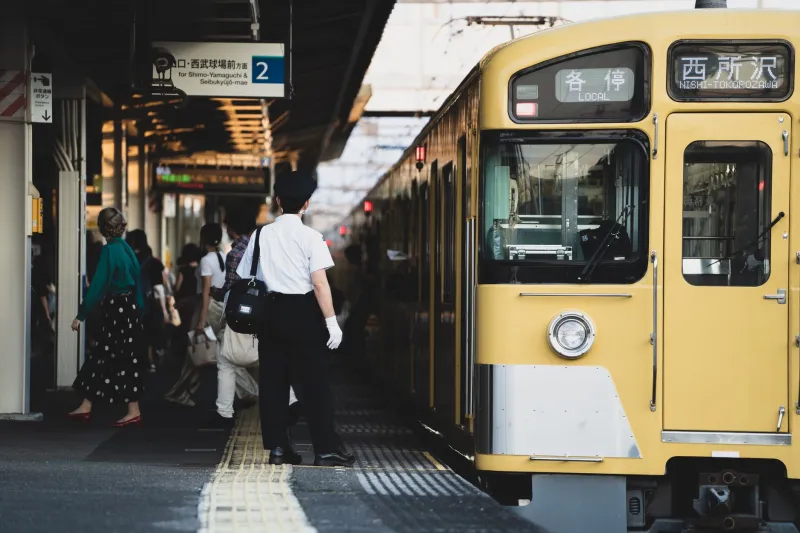
Smaller stations carry their own weight. The intimate platforms of suburban or rural lines — low-roofed, wind-exposed, often attended by just one or two staff members — create a sense of vulnerability that urban terminals deny. Characters standing alone on such platforms are stripped of the anonymity that crowds provide. They are visible, legible, and, in the hands of a skilled director, deeply moving.
Proximity as Pressure
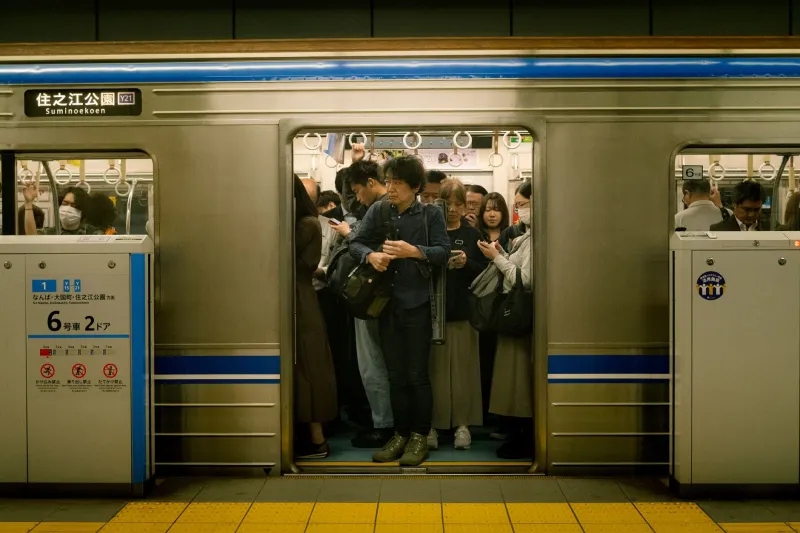
Perhaps no element of Japanese commuting cinema is more foreign to American audiences than the choreography of the packed carriage. In a country where personal space is culturally significant and the private automobile remains a symbol of freedom, the image of dozens of strangers pressed together in a sealed metal tube can read as dystopian. Japanese cinema asks viewers to reconsider that instinct.
Within the crowded carriage, filmmakers construct an environment where social performance becomes impossible to sustain. Salarymen who project authority in the office are reduced to the same physical vulnerability as everyone else. A young woman clutching a job interview folder is indistinguishable, for a moment, from the retired man beside her. The train is one of the few spaces in Japanese social life where hierarchy, while never entirely absent, is temporarily flattened by physical necessity.
Directors exploit this compression with remarkable precision. A glance held a beat too long across a crowded aisle. A hand reaching for a strap and brushing against another. The deliberate avoidance of eye contact that itself communicates a kind of desperate awareness. These micro-gestures, nearly invisible in the context of a wider scene, become monumental in the controlled environment of a train carriage. The camera, when positioned correctly, transforms the mundane geometry of commuter travel into something approaching emotional theater.
The Platform as Threshold
If the carriage is where characters are compressed and revealed, the platform is where they are suspended. Japanese cinema returns again and again to the liminal quality of the platform moment — that interval between arrival and departure, between one chapter of a life and another.
Farewell scenes set on platforms carry a particular weight in Japanese film tradition. The approaching train imposes a deadline that no interior setting can replicate. What is unsaid must remain unsaid; what is said must be said now, in full view of strangers who are themselves absorbed in their own departures. The public nature of these moments does not diminish their intimacy. If anything, it amplifies it, forcing characters to compress enormous emotional weight into gestures that read as ordinary to every observer except the audience, which has been granted access to context that the surrounding crowd has not.
For American viewers, this dynamic can feel revelatory. Hollywood's farewell scenes tend toward the cinematic — airports cleared of crowds, rain falling with narrative convenience, music swelling to guide the emotional response. Japanese platform farewells are frequently the opposite: noisy, crowded, fluorescently lit, and all the more devastating for their refusal to aestheticize grief.
Reading the Commuter Body
Japanese cinema also pays close attention to what the commuting body does when it believes itself unobserved. The way a character stands — whether they grip a hanging strap with white-knuckled tension or sway loosely with the train's motion — communicates psychological state with the efficiency of a paragraph of dialogue. A character who falls asleep on a stranger's shoulder, a common and socially accepted occurrence on Japanese trains, might be read as exhausted, trusting, or simply defeated, depending on what the film has established about them.
This attention to bodily comportment extends to the rituals of commuting itself: the practiced efficiency of boarding before the doors close, the silent negotiation of space, the subtle social contract that governs who gives up a priority seat and who accepts it. Japanese directors understand that these rituals are not background noise. They are behavioral data, and an attentive filmmaker can extract from them a full psychological profile of a character without resorting to a single line of self-explanation.
What American Audiences Gain From Watching
For viewers in the United States, where the commute is more often experienced as a private ordeal behind a steering wheel, Japanese transit cinema offers something genuinely instructive. It proposes that meaning does not require solitude or open space. It suggests that the most profound revelations about who we are and what we want can occur in the most constrained and crowded of circumstances.
There is also, embedded in these films, a quiet argument about community — about what it means to share physical space with strangers day after day, year after year, and to develop, without ever exchanging names, a kind of unspoken solidarity. That argument feels particularly resonant at a moment when American public life is marked by increasing atomization.
Japanese cinema did not invent the idea that transit reveals character. But it has developed that idea into something approaching an art form — one that rewards patient, attentive viewing and returns the effort with a richer understanding of what it means to move through a world that is always, simultaneously, deeply private and inescapably shared.