Shared Cars, Shared Lives: The Democratic Intimacy of Japanese Transit Cinema
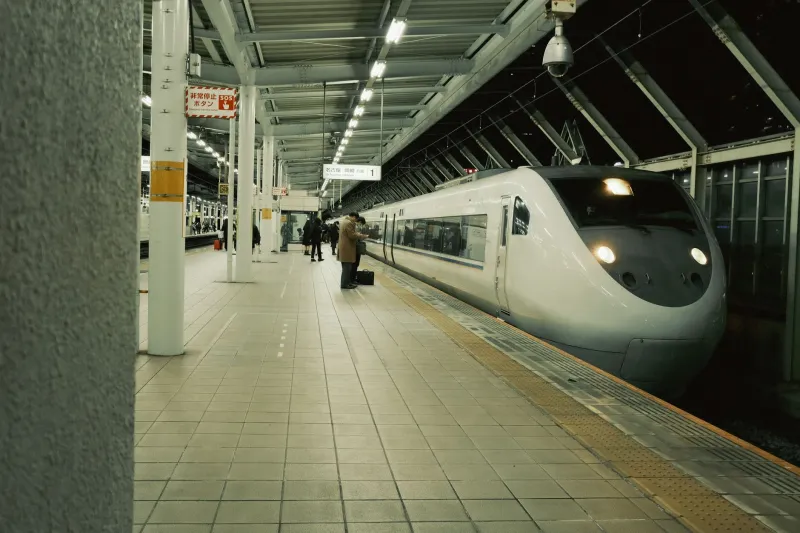
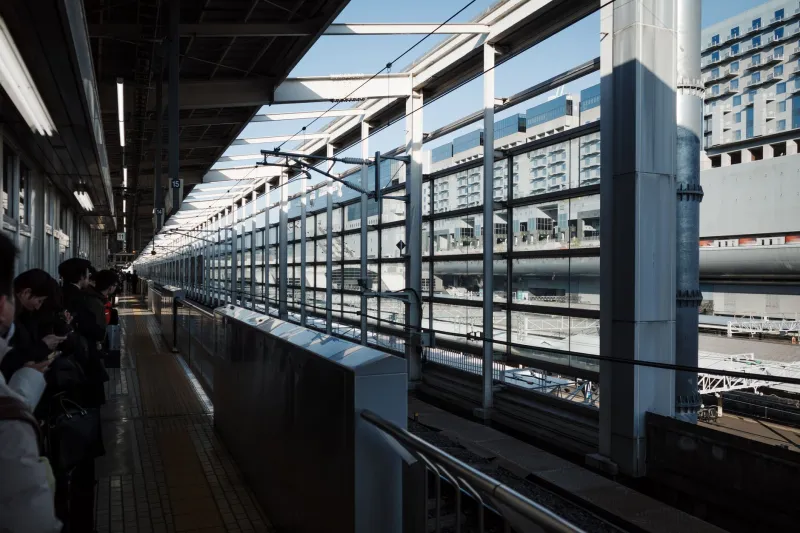
There is a particular quality of light inside a Japanese train car during the evening rush—fluorescent, indifferent, falling equally on the salaryman loosening his tie and the schoolgirl pressing earbuds deeper into her ears. Japanese cinema has always known what to do with that light. It turns the carriage into a confessional, a courtroom, and occasionally a chapel, all without anyone having to say very much at all.
This is not the same as the commute-as-confession-booth that has been previously examined in these pages. What distinguishes the films we are considering here is something more structural: the train car as a genuinely democratic space, one where the usual hierarchies of Japanese social life—age, profession, gender, economic standing—are suspended, however briefly, by the shared fact of motion. Everyone is going somewhere. No one has yet arrived. In that suspension, something quietly extraordinary happens.
The Journey as Relationship
Consider how differently Hollywood uses transit. Trains in American cinema are almost always propulsive—they carry protagonists toward destiny, serve as backdrops for confrontation, or function as elegant metaphors for narrative momentum. The vehicle exists to deliver the story somewhere. Japanese cinema, by contrast, is often content to let the journey be the story itself.
In Nobuhiro Yamashita's Linda Linda Linda (2005), the train sequences that bookend the film do not advance plot in any conventional sense. They accumulate feeling. Characters sit beside one another and do not speak, and the silence is not dramatic tension—it is simply the texture of being young and uncertain and in transit. American viewers trained to read silence as conflict often find themselves recalibrating. The quiet, they eventually understand, is the point.
Similarly, Hirokazu Kore-eda's work returns again and again to transit spaces as sites of involuntary intimacy. In Nobody Knows (2004), the subway becomes one of the few places where the film's isolated children can exist alongside the adult world without being seen as a problem. They are passengers like everyone else. The democracy of the car grants them, temporarily, a dignity the rest of their lives withholds.
Class at the Turnstile
What makes Japanese transit cinema particularly resonant for American audiences right now is its frank acknowledgment that class does not disappear simply because everyone is riding the same line. It persists—in the cut of a jacket, in which station someone boards, in whether a seat is offered or taken. But the train car forces proximity that the rest of organized society works hard to prevent.
Shion Sono's Love Exposure (2008), despite its operatic scale, contains some of Japanese cinema's most precise observations about how strangers read one another in transit. Characters study each other across the aisle with an attention that would be intrusive anywhere else but is somehow permissible in the carriage—because everyone is doing it, and because the journey will end and everyone will scatter, and so the looking carries no consequence.
This is precisely the quality that American viewers, many of whom commute alone in cars or in the studied mutual avoidance of urban transit culture, find so unexpectedly moving. Japanese transit cinema shows people noticing each other. It treats the act of noticing as a form of care.
Motion as the Condition of Honesty
There is a psychological argument buried inside these films that is worth making explicit. Several Japanese directors have spoken in interviews about the train as a space where normal social performance is slightly relaxed—not abandoned, but softened. You are between roles. You have not yet become whoever you need to be at your destination. You are, for a few stops, simply a person in motion.
Masayuki Suo's Shall We Dance? (1996) understands this intuitively. The commute sequences in that film function as a kind of before-and-after: the protagonist on the train is a man whose interior life is visible in a way it never is at the office or at home. The train car catches him in the act of wanting something. It is the most honest place in the film.
For American audiences who spend their own commutes sealed inside vehicles or behind headphones, this cinematic argument for transit as a space of human encounter carries a particular ache. We have optimized our movement to eliminate exactly the kind of accidental contact these films celebrate.
Why Catharsis Arrives at the Platform
The emotional payoff in Japanese transit cinema rarely comes from confrontation or resolution. It arrives, instead, at the moment of departure—when the train stops and passengers disperse and whatever brief communion formed in the carriage dissolves back into the city. The catharsis is in the ending of the intimacy, not its culmination.
This is a structural choice that reflects something genuinely different about how these films understand human connection. Relationships in Japanese transit cinema are not problems to be solved or arcs to be completed. They are encounters to be honored, briefly, and then released.
For viewers accustomed to narratives that insist on resolution—where every meaningful glance must become a conversation, every shared journey a lasting bond—this can feel disorienting at first. Then, gradually, it begins to feel like relief. Not every connection needs to be claimed. Some of the most honest moments of human recognition happen between strangers who will never speak, in a car that is already slowing toward the platform.
Japanese cinema has been documenting this truth for decades. American audiences, it seems, are finally ready to sit still long enough to receive it.