Waiting as Witness: How Japanese Cinema Transforms Liminal Spaces into the Soul of a Story
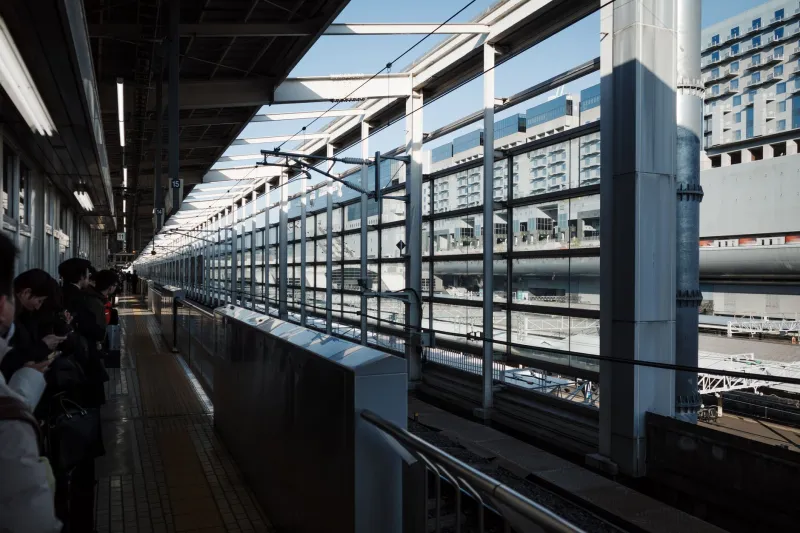
There is a particular kind of stillness that settles over a train platform at 7:43 in the morning—after the express has departed but before the local arrives. In that gap, something true about a person tends to surface. Japanese cinema has known this for decades. Hollywood, by and large, has not.
For American filmmakers, the transit station is typically a device: a place where characters run toward each other, miss each other by seconds, or deliver breathless confessions before boarding. The space itself is scenery. In Japanese filmmaking, however, the waiting room, the underpass, the idling taxi, and the department store escalator are not backdrops. They are arguments about who a person is.
The Geography of Inner Life
Director Hirokazu Kore-eda has built much of his career on the premise that domestic and transitional spaces reveal character more honestly than dramatic confrontation ever could. In Still Walking (2008), the emotional architecture of a family reunion is constructed almost entirely through the choreography of people moving between rooms, stepping onto a narrow veranda, or pausing in a cramped kitchen doorway. No space is neutral. Each threshold a character crosses—or hesitates to cross—communicates something that dialogue would flatten into explanation.
Kiyoshi Kurosawa operates in a different register but with a similar spatial intelligence. His films treat corridors, lobbies, and abandoned storefronts as environments with psychological pressure. Characters do not simply pass through these places; they are acted upon by them. The viewer begins to understand that the architecture of the everyday is not passive. It presses back.
This is a fundamentally different relationship with setting than what most American studio productions offer. In the mainstream Hollywood model, locations serve the plot. In the Japanese model, locations interrogate the character.
What the In-Between Holds
Consider the waiting room as a cinematic instrument. In American film, it tends to function as a brief holding pattern—a place where a character sits until the story resumes. In Japanese cinema, the waiting room is the story. The fluorescent hum, the plastic chair, the clock that seems to move at its own pace: these elements are not atmospheric decoration. They are the precise conditions under which a person's interior life becomes legible.
Shunji Iwai's Love Letter (1995) understands this with particular elegance. Snow-covered streets and quiet post-office interiors carry the film's central grief in ways that no monologue could manage. The characters are always moving between places, and those movements are freighted with longing and memory. The liminal space is where the emotional truth lives.
For American audiences accustomed to films that announce their themes loudly and resolve their tensions cleanly, this approach can initially feel disorienting. Nothing appears to be happening. And then, quietly, everything has happened.
A Different Invitation to the Viewer
What Japanese cinema's treatment of liminal space ultimately offers is an invitation to pay attention differently. The platform, the waiting area, the slow walk through a covered shopping arcade—these are not pauses in the narrative. They are the narrative, rendered in a different key.
This has particular resonance for American viewers who navigate their own version of these spaces daily. The commuter rail platform in Chicago, the hospital waiting room in Houston, the fluorescent-lit break room in an office building in Seattle: these are places where Americans spend genuine portions of their lives, and they are almost entirely absent from the films made for them. Japanese cinema returns those environments to their rightful status as sites of human complexity.
Directors working in this tradition are not romanticizing the mundane for its own sake. They are making a claim about where real life actually occurs. Not in the climactic confrontation or the dramatic revelation, but in the moment before—in the held breath, the averted glance, the hand that reaches for a door handle and then does not turn it.
Spatial Restraint as Narrative Strategy
There is also a structural argument embedded in this approach. By refusing to skip over the transitional moments, Japanese directors create a sense of temporal authenticity that their Hollywood counterparts rarely achieve. Time in these films feels like actual time. The viewer is not shuttled efficiently from plot point to plot point. Instead, they are allowed to inhabit the duration of a character's experience.
This matters because duration is where empathy develops. The longer a viewer spends with a character in an unremarkable space, the more completely they come to understand that character's interior weather. The waiting room scene that lasts three minutes longer than an American editor would permit it to is not indulgent. It is precise.
Kore-eda has spoken in interviews about his interest in what happens at the edges of scenes—the moment before the camera conventionally starts rolling, or the moment after it conventionally stops. His films often feel as though they have captured something that was not meant to be seen. That quality of accidental truth is not accidental at all. It is the product of a deliberate commitment to the spaces most filmmakers discard.
What American Cinema Leaves on the Platform
The irony is that American daily life is saturated with exactly the kind of liminal experience that Japanese cinema renders so powerfully. Millions of Americans wait, commute, pause, and occupy in-between spaces every single day. The emotional texture of those experiences—the particular loneliness of a crowded subway car, the strange intimacy of a shared waiting room—is a largely untapped reservoir of cinematic material.
Japanese directors have been drawing from that reservoir for generations. Films arriving from studios in Tokyo and Osaka carry with them a spatial vocabulary that American audiences are increasingly recognizing as a more honest portrait of lived experience than the efficiently edited, location-as-backdrop approach they have long accepted as the default.
To watch Japanese cinema with genuine attention is to begin seeing your own daily environments differently. The platform becomes a stage. The waiting room becomes a confessional. The escalator becomes a slow, involuntary meditation. The in-between moments stop being time lost and start being time inhabited.
That is not a small gift for a film to offer. It may, in fact, be the most important one.